
Fueled has begun piloting Claude Design workflows where AI-assisted production offers the most promising leverage, without compromising impact or quality.
The release of Claude Design, an integrated product experience backed by Anthropic’s investment, brings more structure to a workflow many project teams were already adopting. Before these capabilities were available in a first-party product, practical AI-assisted design work required designers to connect LLMs like Claude to production tools like Figma through MCP and custom workflows. That kind of setup can be powerful, but it is harder for larger organizations to govern, support, and scale.
Our early pilot work is reinforcing a clear pattern: these tools become dramatically more powerful as design moves from expressive and conceptual work into structured production and delivery. They can add breadth to early exploration, but the largest gains appear when teams use established design direction to produce layouts, prototypes, reusable patterns, and interface variations.
That shift creates more room for creative talent to focus upstream. As AI reduces the effort required for more mechanical production work, more attention and investment can go toward the human-led art direction that makes brands stand apart from generic AI-led expression, as well as improvements to structured design-systems that unlock the greatest gains from AI output.
Where Claude Design is strongest
Fueled designers are piloting applications of Claude Design across the design process, but its impact is not equal at every stage. The value curve rises as the work becomes less expressive and more structured.
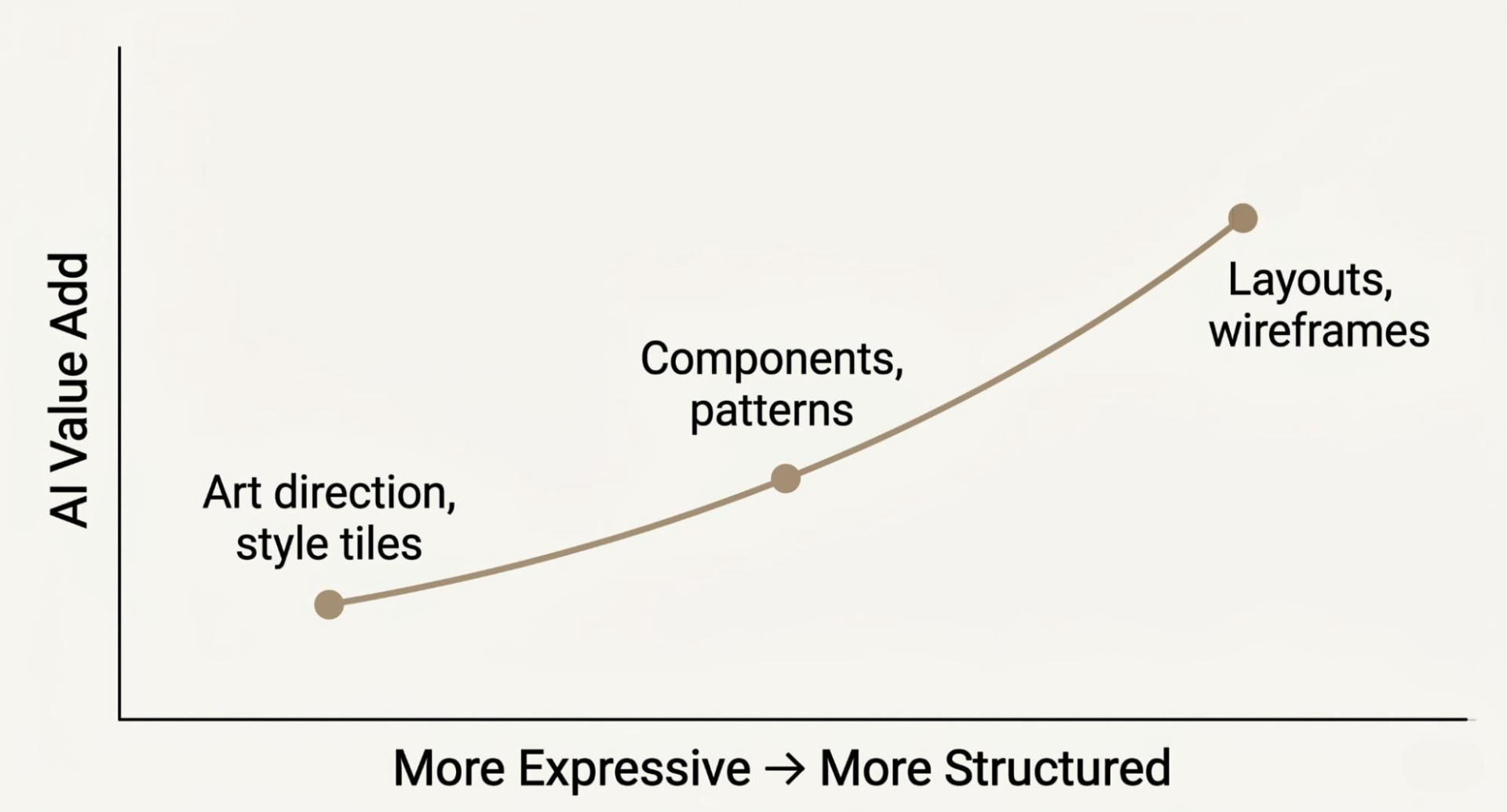
At the earliest stage of design, Claude Design is helping our teams move faster through exploration. Designers are using it as a brainstorming partner to explore art direction, pressure-test style tiles, try color palettes, evaluate typographic treatments, and generate a wider range of visual motifs.
The benefit at this stage is incremental. Claude Design can increase the speed and breadth of exploration, but when it carries too much of the creative direction, the output often looks polished and familiar. Competent, but not especially ownable or distinctive.
For premium brand experiences, our designers’ creativity is still inseparable from distinctive design direction: how the brand should feel, what the audience should remember, where the experience needs emotional weight, and which product moments deserve more original expression. Claude Design expands the design conversation, but human taste and judgment still determine whether the final experience resonates.
Once a designer has established a clear direction, Claude Design becomes much more useful. In our pilot work, designers are using it to accelerate translating art direction into reusable patterns, interface elements, components, and design-system extensions.
However, the biggest gains are showing up when a mature design system and, ideally, a component library are established. On those projects, Fueled designers are dramatically accelerating the production of layouts, templates, wireframes, prototypes, and alternate page structures.
One of our principal designers estimated she is more than doubling the number of layout directions and prototype explorations she can produce in the same amount of time using Claude-assisted workflows.
When basic brand direction is enough
Our Managed Services team is already applying Claude Design in more utilitarian product contexts, where speed, clarity, and consistency matter more than highly expressive visual invention.
An engineer loaded Fueled’s basic brand language into Claude Design to generate a utilitarian dashboard interface, including reusable components.
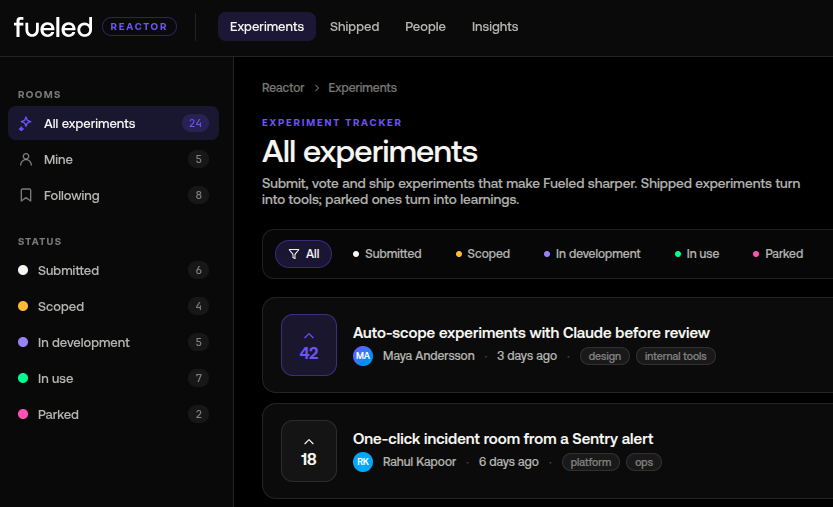
This was not a product surface that needed a wildly original visual system. It needed to be clear, on brand, easy to use, and competently structured. Claude Design compressed the production work and helped the work move closer to implementation without waiting for immediate design-team availability.
For more utilitarian tools, operational dashboards, admin interfaces, and other functional product surfaces, that acceleration is especially valuable. These experiences still need to meet a high bar for usability and brand alignment, but they often do not require highly expressive visual invention. For certain surfaces, familiar, competent, on-brand design at a fraction of the time investment is the appropriate level of effort.
That is one side of how Fueled is using Claude Design today: when the surface is functional or resources are more constrained, basic brand direction can be enough of an unlock to leverage AI-native design platforms. The other side is client work where the digital experience carries more of the brand. In those cases, the maturity of the design system has a much bigger impact on how useful AI-assisted design can be.
Design systems are becoming AI infrastructure
That pattern shows up clearly in work tied to a major grocery retail chain, where Fueled had already delivered a mature design system.
Because the brand language, reusable components, and visual patterns were already established, AI design tools had something strong to work from. Our designers are leveraging the design system to quickly generate credible, brand-aligned layouts and alternate page directions.
The value came from extension, not invention. Claude Design was able to move faster because the system already defined what “good” looked like for that brand: the components, patterns, constraints, and visual decisions that made the experience feel specific rather than generic.
That is why design systems are becoming AI infrastructure. For organizations that care about distinctive digital expression, design systems are no longer just governance tools. They are becoming the foundation that makes AI-assisted design more useful, more reliable, and less generic.
For years, teams have invested in design systems to create consistency, reduce rework, and help large organizations move faster without drifting off brand. Those benefits still matter. AI changes the leverage. A strong system gives these tools better raw material, clearer rules, and stronger constraints.
The web was already converging before generative AI arrived. Many digital experiences already share familiar layouts, navigation models, UX conventions, and visual trends. Claude Design has not invented that tendency. It accelerates it.
These tools can dramatically increase output. The better question is whether teams can move faster without flattening their digital experience into something generic.
For clients with mature systems, AI-powered design becomes a multiplier on strategy, brand direction, design systems, and taste. It helps teams extend good decisions faster. Without that foundation, speed becomes a faster path to bland sameness.
What design teams should spend more time on
Our pilot work with Claude Design is beginning to show how AI can shift designers’ time toward higher-value creative work within traditional and even more constrained budgets.
By reducing the effort required for mechanical production, these tools are creating more space for the work that drives real differentiation: judgment, storytelling, emotional impact, interaction quality, and original brand expression.
Less time manually producing every variation. More time exploring a wider set of design directions and determining where a brand needs to feel distinctive, and where a simpler, more systemized approach is enough.
Senior Director of Design & Research Paige Maguire recently wrote about how AI is shifting the value of agency work away from pure production bandwidth and toward the ability to deliver tasteful design that audiences actually trust. Claude Design is one example of that shift becoming more concrete inside our own workflows.
If your organization wants to work with a team that is actively using Claude Design and AI-native workflows to accelerate production, expand creative possibilities, and keep design judgment at the center of the work, let’s talk.