

Maze’s 2026 Future of User Research Report draws on a survey of nearly 500 researchers, designers, and product professionals.
Here’s the short version: AI has become table stakes, research is reaching the boardroom, and the systems supporting it haven’t kept pace.
Trend 1: AI is now the baseline
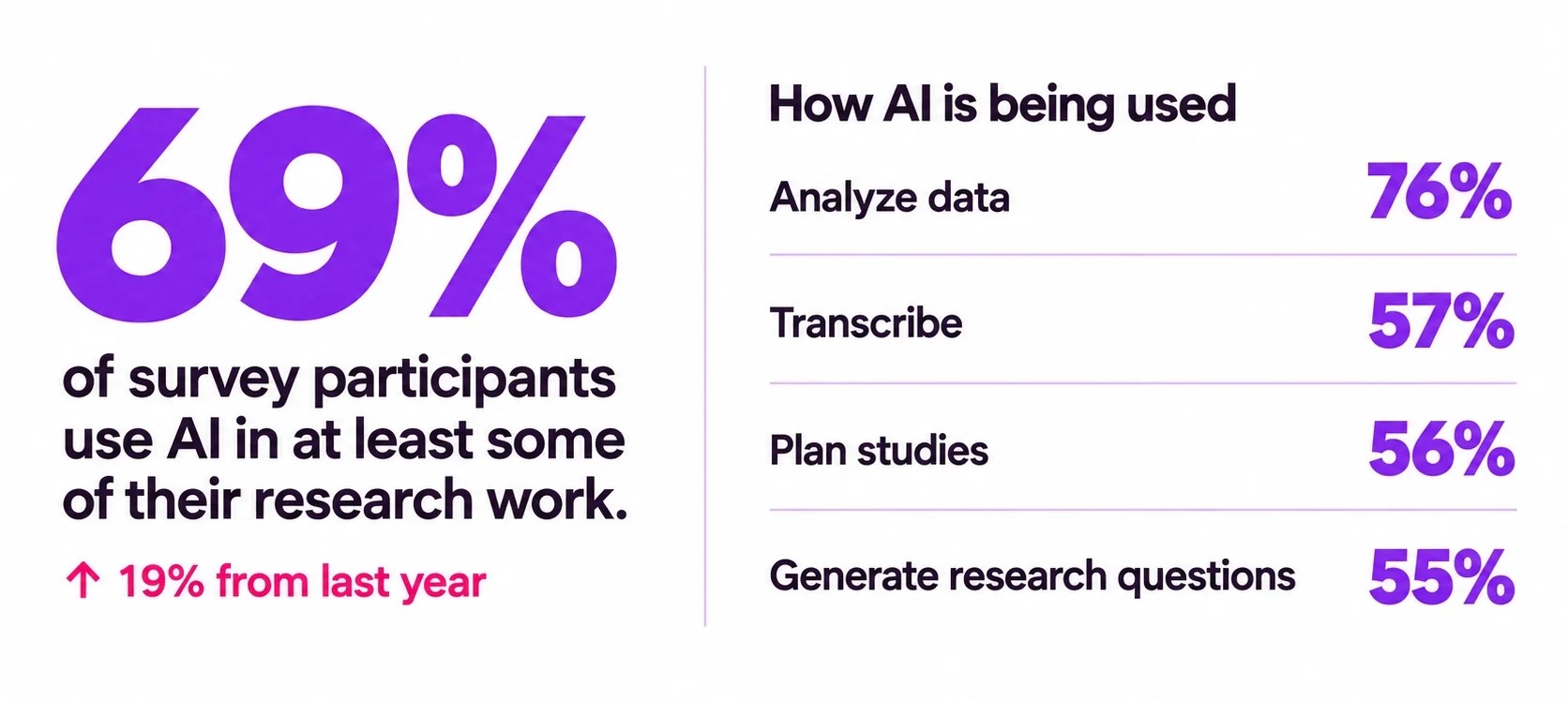
69% of survey participants now use AI in at least some of their research work, a 19% increase from last year. It’s being used to analyze data (76%), transcribe (57%), plan studies (56%), and generate research questions (55%).
The report emphasizes the continuing role of human judgment. When participants were asked where it remains essential, the answers were consistent: interpreting nuance and emotion (82%), ethical decision-making (80%), framing the right questions (76%), and translating findings into strategic recommendations (66%).
Teams need to establish which work AI can accelerate and who is responsible for interpreting the evidence and recommending action. A faster synthesis still needs someone to assess whether the study reached the right customers, what the findings mean in context, and how they should affect the roadmap.
The time saved on execution should create more room to understand what the business should do next.
A faster synthesis still needs someone to assess whether the study reached the right customers, what the findings mean in context, and how they should affect the roadmap.
Trend 2: Research influence is reaching the boardroom
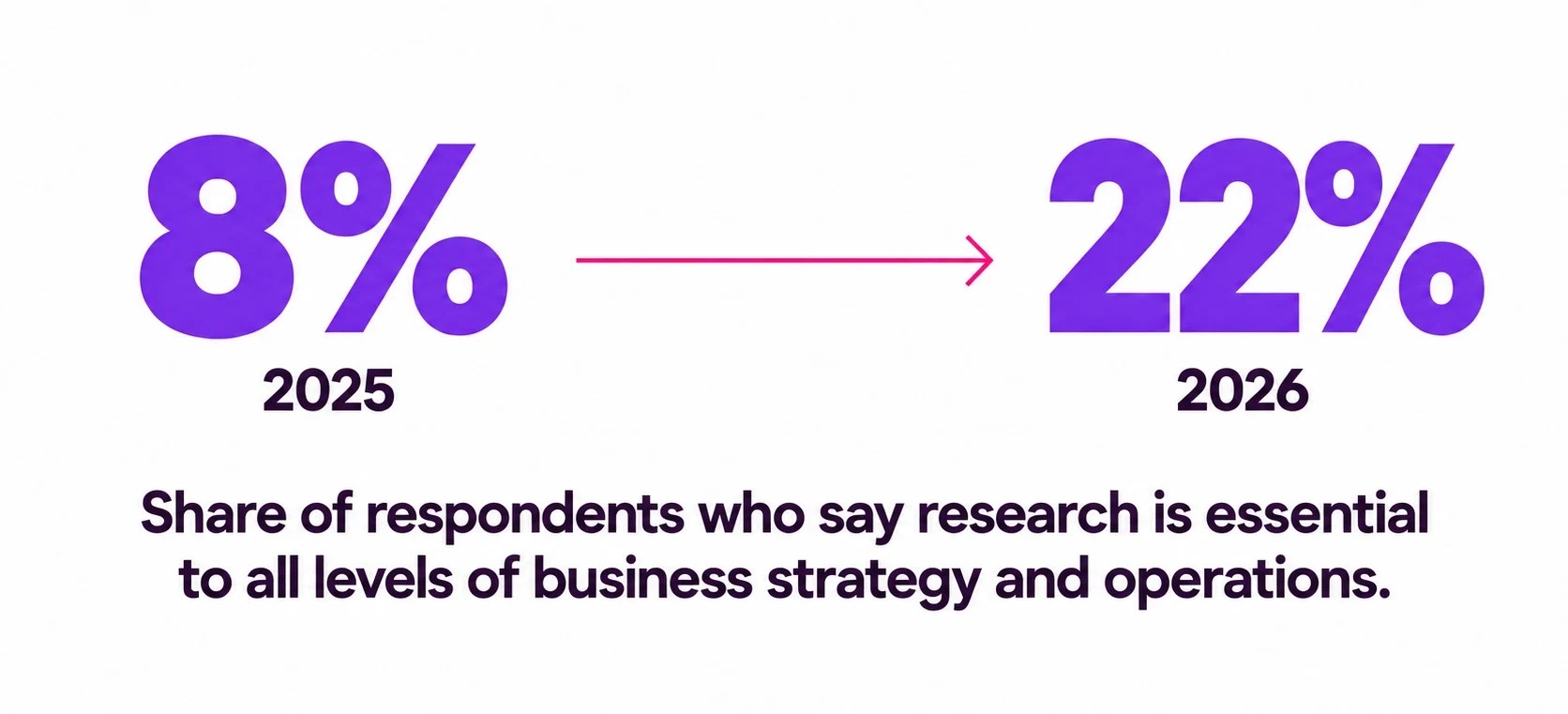
This is the headline stat: the share of respondents saying research is essential to all levels of business strategy and operations nearly tripled, from 8% in 2025 to 22% in 2026. Another 41% say it informs both product and strategic business decisions.
It’s also spreading horizontally. Beyond UX researchers (69%) and designers (55%), product managers (39%) and market researchers (35%) are running studies. More teams are using the findings, too: the share reporting that sales incorporates research into decisions more than doubled, and executive-team use increased as well.
What earns that authority? Clear business metrics and outcomes lead the report’s measures of executive trust, followed by strong storytelling (57%) and direct customer exposure (48%). Speed ranks lower, and only 17% cite AI-supported analysis as a trust-builder.
Customer evidence needs to arrive early enough to change priorities and funding. Planning conversations should include research recommendations that explain the customer need, the business implication, and the tradeoff involved. A finding about where customers struggle should help leaders decide which problem deserves investment and what success would look like.
Trend 3: Demand for research is outpacing the systems built to support it
The uncomfortable part of the story: the share of participants reporting increased demand for research rose from 55% to 66%, but the infrastructure to support that demand hasn’t kept pace. Only 45% report dedicated support from specialized researchers, 46% report training sessions or workshops, and 13% report no support resources at all for non-researchers conducting studies.
Participants describe inconsistent methods, findings scattered across tools, and teams redoing work that’s already been done elsewhere in the organization. Research requests are growing without a consistent way to conduct the work or find previous studies.
Scaling research requires shared expectations for how studies are designed, when specialist support is needed, and where findings are stored. Product managers running their own studies need access to both practical guidance and experienced researchers. Teams also need to preserve enough context around findings for colleagues to understand who participated, what was asked, and where the conclusions apply.
Scaling research requires shared expectations for how studies are designed, when specialist support is needed, and where findings are stored.
The thread that connects all three
Maze frames 2026 as a moment of growing influence for research. Sustaining that influence depends on the systems and culture around it: how people exercise judgment, how findings reach decision-makers, and how teams learn from one another.
That reinforces our approach to embedding research throughout product delivery. Customer understanding needs to move with the work as priorities evolve and new questions emerge.
If you’d like to learn how Fueled can help turn customer insight into product priorities and design decisions for your organization, reach out.