
We rebuilt A to Z Sports on WordPress and Pantheon, using AI-native delivery to simplify publishing, strengthen content discovery, and support new fan-facing digital products ahead of the NFL Draft.
A to Z Sports has built a fast-growing sports media business around timely coverage, strong editorial voices, and an audience that wants more than headlines.
With writers covering every NFL franchise and college football for an audience spanning millions of social followers, hundreds of thousands of newsletter subscribers, and more than 100 million page views over the last two years, the team needed a publishing platform that could support growth without slowing down the people responsible for creating it.
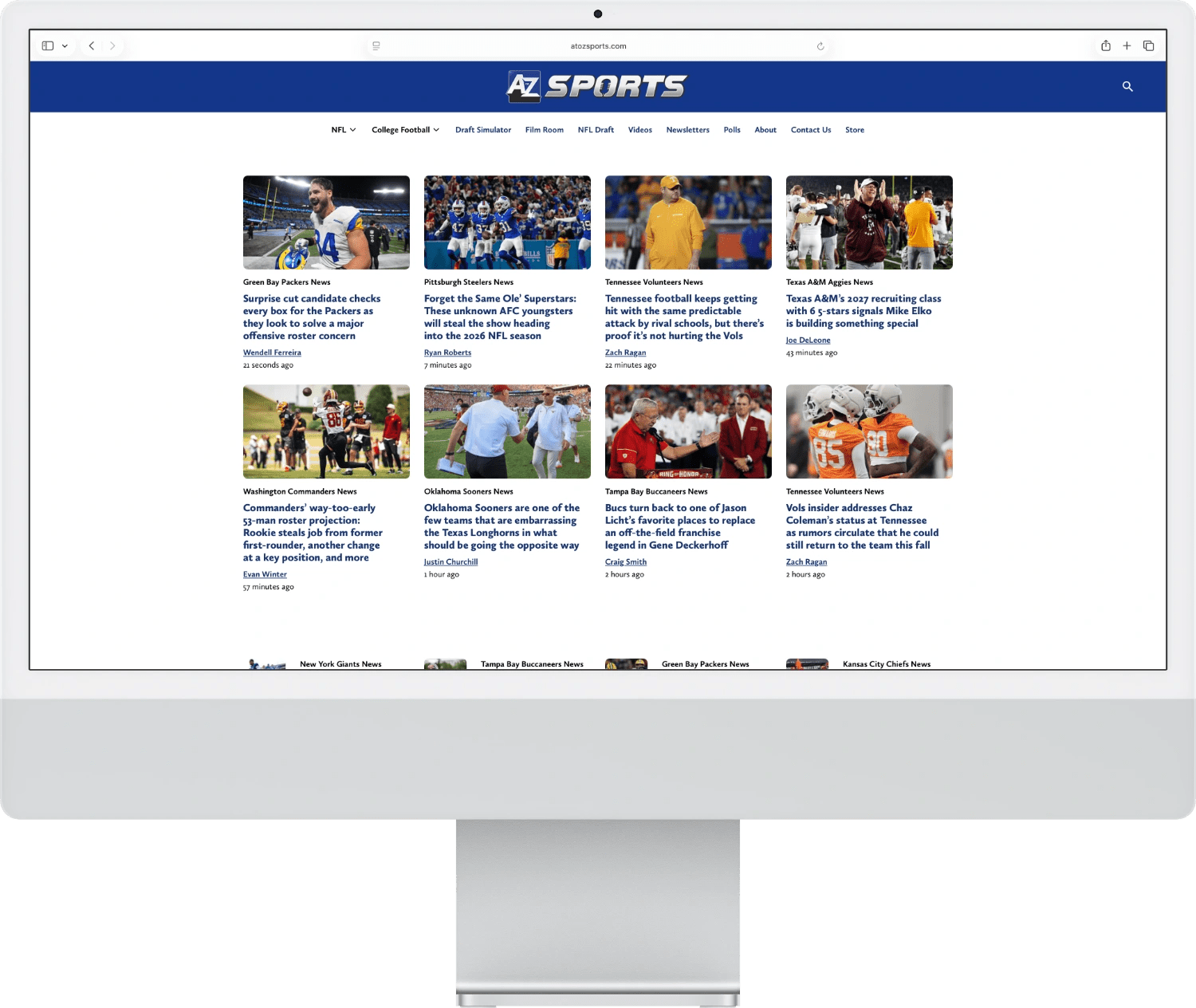
Fueled partnered with A to Z Sports to rebuild its site on WordPress, hosted on Pantheon, ahead of a major NFL Draft traffic window. Rather than redesigning the site from the ground up, our team preserved the reader-facing experience while simplifying the CMS, migrating content, supporting advertising and syndication workflows, and preparing the platform for future fan-facing tools.
AI-native delivery helped protect the project timeline and budget. Fueled engineers paired Claude with custom WordPress MCP tooling, project-specific instructions, migration scripts, and Fueled-specific validation practices shaped by our WordPress standards. Fueled’s tooling and AI-native approach helped the team move fast enough to meet the deadline while keeping quality control and expert engineering judgment at the center of the work.
Choosing an architecture built for the business
A to Z Sports previously used WordPress as the backend with a separate frontend application layer. That headless architecture can be the right choice for highly customized product experiences, but for an article-driven media business, it was solving problems that a well-built WordPress platform on Pantheon could address more directly, while adding maintenance cost and operational complexity.
The team needed a platform with lower operating overhead, fewer moving parts, and a clearer path for growth as the business expanded from daily coverage into new fan-facing digital products. The new architecture also needed to launch before the NFL Draft.
Fueled rebuilt the site on a dedicated WordPress architecture hosted on Pantheon, with a custom theme that preserved the existing design and content strategy while simplifying the platform underneath it. The cleaner architecture made the site easier to operate and extend, and gave future engineering work, including AI-native delivery workflows, a more legible foundation to build on.
Pantheon gave the engagement a familiar operating path. Fueled’s long-standing partnership delivering WordPress projects on Pantheon helped reduce uncertainty around environments, deployment workflows, search infrastructure, and launch readiness.
The site looked familiar to readers, but the platform behind it became cleaner, more focused, and better prepared for expansion.
Streamlining the workflows behind daily coverage
For A to Z Sports, a better CMS was not only about moving content into a new environment. The previous workflow had turned basic publishing tasks, such as selecting authors, tags, or categories, into overengineered steps. For a team covering games, draft cycles, breaking news, and team-specific coverage, that friction slowed down the work behind every article.
Fueled built the new WordPress theme with simpler editorial workflows in mind, using Gutenberg-based blocks and templates to give editors more structured tools for creating and managing content without changing the site’s overall design. The goal was to keep the site familiar to fans while making the work behind each article faster, cleaner, and easier to control inside WordPress.
The engagement also addressed the operational details that shape how a newsroom actually runs. For example, Fueled added a “silent updates” capability that allows certain article edits to happen without changing the post’s modified date. For a publisher, that can prevent small corrections from triggering downstream systems or making an article appear newly updated when the editorial intent is simply to fix or refine it.
Distribution workflows needed attention, too. Fueled tailored RSS feeds for syndication partners, including MSN and AOL, where standard WordPress feeds did not meet partner requirements.
Monetization requirements also evolved during the engagement. As A to Z Sports explored different ad partners and different ways to place ad placeholders within content, Fueled adapted the implementation to support those changing needs.
Collectively, the work delivered a publishing environment better aligned with the real mechanics of sports media: creating content quickly, updating it responsibly, distributing it to partners, monetizing it effectively, and keeping the editorial team in control.
Strengthening content discovery with ElasticPress on Pantheon
A to Z Sports’ archive is deep and constantly growing, spanning teams, players, draft coverage, and college football. Strong search turns that archive into a more useful product experience, helping fans find the stories they came for while giving the business more value from the content it has already created.
Fueled brought its ElasticPress solution, originally created by 10up and now part of Fueled, to Pantheon-managed Elasticsearch. Pantheon handled the infrastructure, including provisioning, scaling, and uptime, while ElasticPress connected that search capability to WordPress.
That gave A to Z Sports a stronger search experience for a deep and fast-moving archive. Pantheon reported that within weeks of launch, AtoZSports.com had processed more than 12,000 search queries, with search activity reaching roughly one query per second. Fueled also implemented custom result weighting and filters by team or player, helping readers get to relevant coverage faster.
Search also gives the editorial team another signal into audience intent. On-site search behavior can reveal which teams, players, and storylines visitors are actively looking for, turning search into both a discovery tool and a source of editorial insight.
Using AI-native delivery to protect the launch window
A to Z Sports needed more than a fast rebuild. The engagement had a fixed launch window, limited source materials, evolving business requirements, and a platform that needed to be maintainable after launch. Fueled’s AI-native delivery approach gave the engineering team more leverage across that work, from legacy discovery and migration planning to implementation decisions, documentation, and validation.
The approach paired Claude with custom WordPress MCP tooling, project-specific instructions, migration scripts, and review practices shaped by Fueled’s WordPress standards. That structure helped the team move quickly without handing quality control to generic model output.
The first major test was migration, which required more than moving content from one system to another. Fueled needed to understand how the legacy site’s content blocks were being used, how often they appeared, what variations existed, and how those structures should map into the new WordPress build.
In a traditional migration, engineers often spend hours manually reviewing content and components to decide what to recreate, replace, or retire. Using AI-native workflows, Fueled analyzed the database and identified the most-used blocks, their attributes, and their variations. Work that often required as much as 20 hours was reduced to minutes.
Across the migration effort, Fueled’s approach saved an estimated 80+ engineering hours, helping the team stay within budget and meet the launch window.
AI workflows also helped Fueled efficiently generate stronger project documentation, including a more detailed record around key decisions, reducing the knowledge loss that can make inherited platforms harder to maintain.
The added leverage showed up in the final handoff: faster delivery, stronger documentation, clearer technical context, and a platform built with quality control still centered on experienced engineers.
Helping an AI-built Draft Simulator reach launch
With Fueled leading the site modernization, A to Z Sports kept pushing on the larger strategic question facing sports media in the AI era: how to expand beyond articles and build direct fan experiences that give audiences a reason to keep coming back.
Fueled is seeing the same pattern across media work: trusted brands are extending beyond articles into interactive products that create more direct, repeatable audience engagement. Ahead of the NFL Draft, the A to Z Sports team used AI to build a Draft Simulator: a fan experience that let visitors step into the draft room, make picks, consider trades, and receive a grade on their selections.
Before going live, Fueled helped turn the prototype into a launch-ready product, supporting deployment on Pantheon, server infrastructure, GitHub workflows, ad loading, layout refinements, and launch readiness.
The gap between a working prototype and a live fan experience showed up in the unglamorous parts: deployment, version control, infrastructure, monetization, and production workflows. AI can help teams create prototypes quickly, but real audiences need digital products that are stable, maintainable, and ready to support the business around them.
The Draft Simulator generated 350,000 page views in its first month, with sessions averaging 6 to 10 minutes per visitor, showing how interactive tools can create deeper fan engagement around high-interest sports moments. It also points toward a larger product opportunity: using AI to experiment faster, then relying on experienced engineering partners to help make those experiments ready for real audiences.
“That opened our eyes to so many great things we can build and put in front of our audience. Two years ago, we were just concentrating on writing articles. Now we’re producing videos, writing articles, sending newsletters, and creating experiences like our simulator.”
Zach Bingham, CEO, A to Z Sports
Built for faster publishing and richer fan engagement
The new A to Z Sports site gives a 20+ person editorial team a more manageable WordPress workflow without forcing readers into an unfamiliar experience. Behind the scenes, the platform is better prepared for the realities of a modern sports media business: frequent publishing, advertising changes, syndication needs, search-driven discovery, and major traffic windows around events like the NFL Draft.
The Draft Simulator showed where that foundation can go next: faster experimentation, more direct fan engagement, and a clearer path from AI-generated prototype to production-ready experience.
A to Z Sports now has a platform built for daily coverage and for the interactive products that give fans more reasons to return.