
beehiiv partnered with Fueled to create its official WordPress plugin, making its audience-growth and monetization tools easy for publishers to adopt without replacing the CMS or disrupting editorial workflows.
As search and social traffic become less dependable, publishers are under pressure to build stronger direct audience relationships and more durable sources of revenue. beehiiv has built a platform that treats newsletters as more than email distribution, combining publishing with tools for subscriber growth, first-party audience insights, paid subscriptions, and advertising. By Q2 2026, more than 170,000 publications were on beehiiv, and users had earned more than $60 million through the platform.
Many digital publishers, however, run their core editorial operations in WordPress, the world’s most widely used CMS, powering more than 40% of all websites. Without an official integration, adopting beehiiv could mean sending writers and editors into a separate workflow or asking an engineering team to build and maintain a custom connection. For lean publishing teams, that friction could put the platform’s broader value out of reach.
beehiiv partnered with Fueled to remove that barrier. Together, we designed and built the official beehiiv WordPress plugin, making the platform easier to use alongside WordPress without requiring publishers to replace their CMS or fragment their day-to-day editorial work.
Fueled has been one of the best partners we’ve worked with, hands down… Fueled knows WordPress inside and out, while we know beehiiv inside and out, and that split let us move pretty fast.
Viktor Tretyak, Senior Manager of Solutions Engineering, beehiiv
Applying lessons from a successful publisher integration
Fueled had already seen this need firsthand through a successful custom beehiiv integration for the 9to5 network, including 9to5Mac and Electrek. That work showed how much editorial friction could be removed when writers could send a WordPress post through beehiiv without recreating it in a second system. It also gave our team practical insight into the publishing decisions, content mapping, and platform coordination an official product would need to address.
For the official plugin’s first release, beehiiv and Fueled focused on three immediate publisher needs: distributing WordPress content through beehiiv without recreating it in a second system, adding beehiiv signup forms to any page or post without manually embedding code, and bringing beehiiv advertising opportunities into the WordPress publishing workflow. Together, those capabilities give publishers a practical starting point for reaching, growing, and monetizing an email audience, while establishing product and technical foundations for the plugin to evolve.
Designing for the way publishers already work
The plugin needed to feel like a natural part of WordPress rather than another publishing system layered on top. Working closely with beehiiv’s product and engineering teams, we focused the experience on the day-to-day publishing decisions writers and editors make: whether a post should become a newsletter, when it should be sent, how much of the article subscribers should receive, and where signup opportunities should appear.
Making setup simple and secure
Publishers can connect their existing beehiiv account through OAuth, a secure authorization flow that avoids manually managing API credentials. From a dedicated WordPress settings screen, they choose the relevant beehiiv publication and default newsletter template.
OAuth was one of the clearest examples of the partnership behind the plugin. Fueled helped guide the authorization approach and improve parts of beehiiv’s implementation, while beehiiv brought deep knowledge of its platform and API.
Once configured, editorial teams can keep working in WordPress while beehiiv continues to handle subscriber management and email delivery.
Keeping editors inside WordPress
Within the WordPress block editor, writers can decide whether a post should also be sent as a beehiiv newsletter, send it immediately or schedule it for later, and choose whether subscribers receive the full article or a teaser linking back to the website. The plugin keeps the WordPress post connected to its beehiiv counterpart, reducing the risk of accidental duplicate sends.
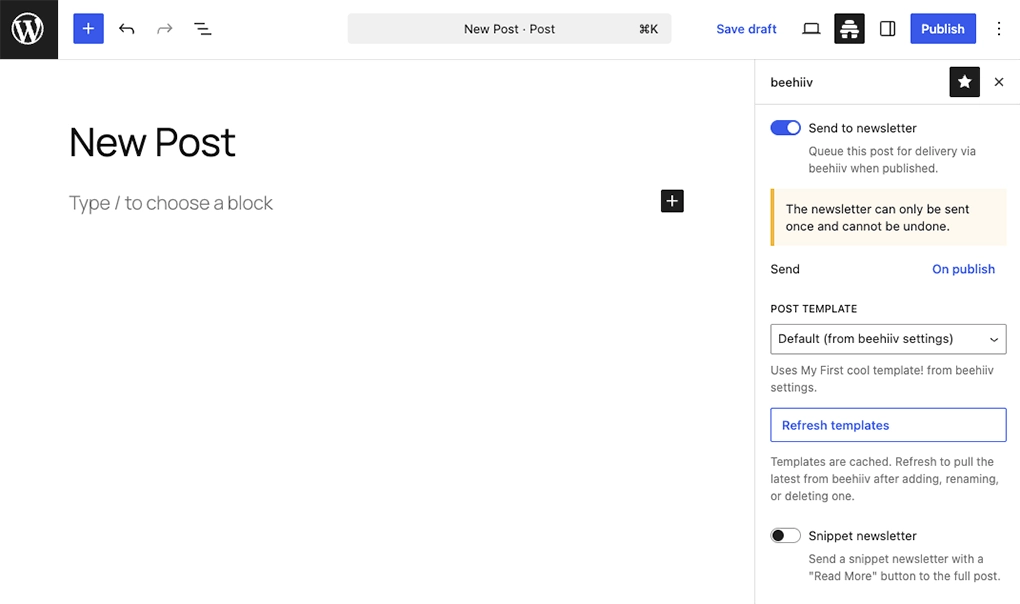
Newsletter distribution becomes part of the same workflow used to publish the web story in WordPress, rather than a separate process that requires editors to recreate the content elsewhere.
Bringing newsletter monetization into WordPress
The plugin brings beehiiv advertising opportunities into WordPress through a dedicated block. Editors select an eligible advertisement alongside the newsletter content while keeping it out of the corresponding webpage.
The plugin tracks opportunities across posts to prevent the same advertisement from being selected twice and warns editors if a selection becomes unavailable before sending.
Editorial teams can manage sponsored placements within the same workflow used to produce and distribute the story.
Building a translation layer between publishing systems
In practical terms, the plugin turns content structured for a WordPress webpage into content beehiiv can render as an email newsletter.
Making that feel simple for editors required a substantial translation layer behind the scenes. WordPress articles are composed from a hierarchy of Gutenberg blocks and HTML, while beehiiv’s API expects content in its own structured block schema.
Fueled built a system that parses the WordPress block tree and reconstructs supported content as beehiiv-native blocks. Dedicated converters handle headings, images, lists, tables, quotes, buttons, embeds, Media & Text layouts, featured images, and sponsored content. A separate rich-text parser preserves supported details such as links, emphasis, colors, highlights, and alignment by translating them into beehiiv’s formatted-text segments.
The editor warns publishers before sending when a post contains unsupported blocks, such as site-specific custom components or interactive elements without a useful email equivalent. If a send fails, editors receive a clear error and can retry without the post being treated as already sent. For editors, the payoff is simple: content moves from WordPress into beehiiv without being rebuilt by hand.
Making subscriber growth part of publishing
Newsletter growth depends on making signup opportunities easy to place wherever readers encounter content. Fueled built a native WordPress block that lets publishers add an existing beehiiv subscription form to any page or post.
This replaces manual embed code with a familiar editing experience, making subscriber acquisition part of day-to-day site publishing rather than a separate technical task.
Bringing an official product to WordPress.org
Fueled managed the work required to publish the plugin through WordPress.org, including packaging, documentation, quality assurance, release preparation, and the submission and review process.
The more platforms that integrate with beehiiv, the faster customers can get connected… and start getting value within hours instead of days or weeks.
Viktor Tretyak, Senior Manager of Solutions Engineering, beehiiv
Giving more publishers a path to newsletter growth
With the official plugin available on the WordPress.org plugin directory, beehiiv customers can connect their WordPress sites without commissioning a custom integration or asking editors to recreate web content in a second system. Publishing teams can send articles as newsletters, place signup forms throughout their sites, and incorporate beehiiv sponsored content from the environment they already use.
That gives publishers an immediately useful path into beehiiv’s audience-growth and monetization platform. For beehiiv, the official integration simplifies a recurring question in sales and post-sale onboarding: how WordPress publishers will connect the two systems.
More broadly, the project advances beehiiv’s vision for an open, connected platform and establishes a strong foundation for the plugin to evolve alongside the publishers it serves.