


Fueled is piloting Agentic Post-Launch Support, an AI-native maintenance model for qualified web and mobile products designed to deliver more value from post-launch investment. The pilot is focused on building reliable, repeatable agentic maintenance workflows for continuous monitoring, automated triage, AI-drafted fixes, and reporting, while experienced product and engineering leads remain responsible for priorities, quality, and what ships.
The need is familiar to anyone responsible for a product after launch. Real usage surfaces crashes, performance issues, edge cases, and defects across devices, operating systems, account types, and user journeys. Some issues are obvious and repeatable. Others appear as sparse reports, intermittent failures, or low-volume error patterns that are difficult to justify investigating one by one through a traditional maintenance workflow.
Left unresolved, those issues can quietly accumulate. A growing backlog of small and intermittent defects can erode conversion, retention, and trust in the product over time.
The program makes it more efficient to investigate and resolve post-launch issues that may not justify manual attention on their own, but still shape product quality. For products in quieter maintenance phases, that means better continuity after launch. For larger product teams, it means routine support work can consume less time and attention that should be going toward meaningful product improvement.
How Agentic Post-Launch Support works
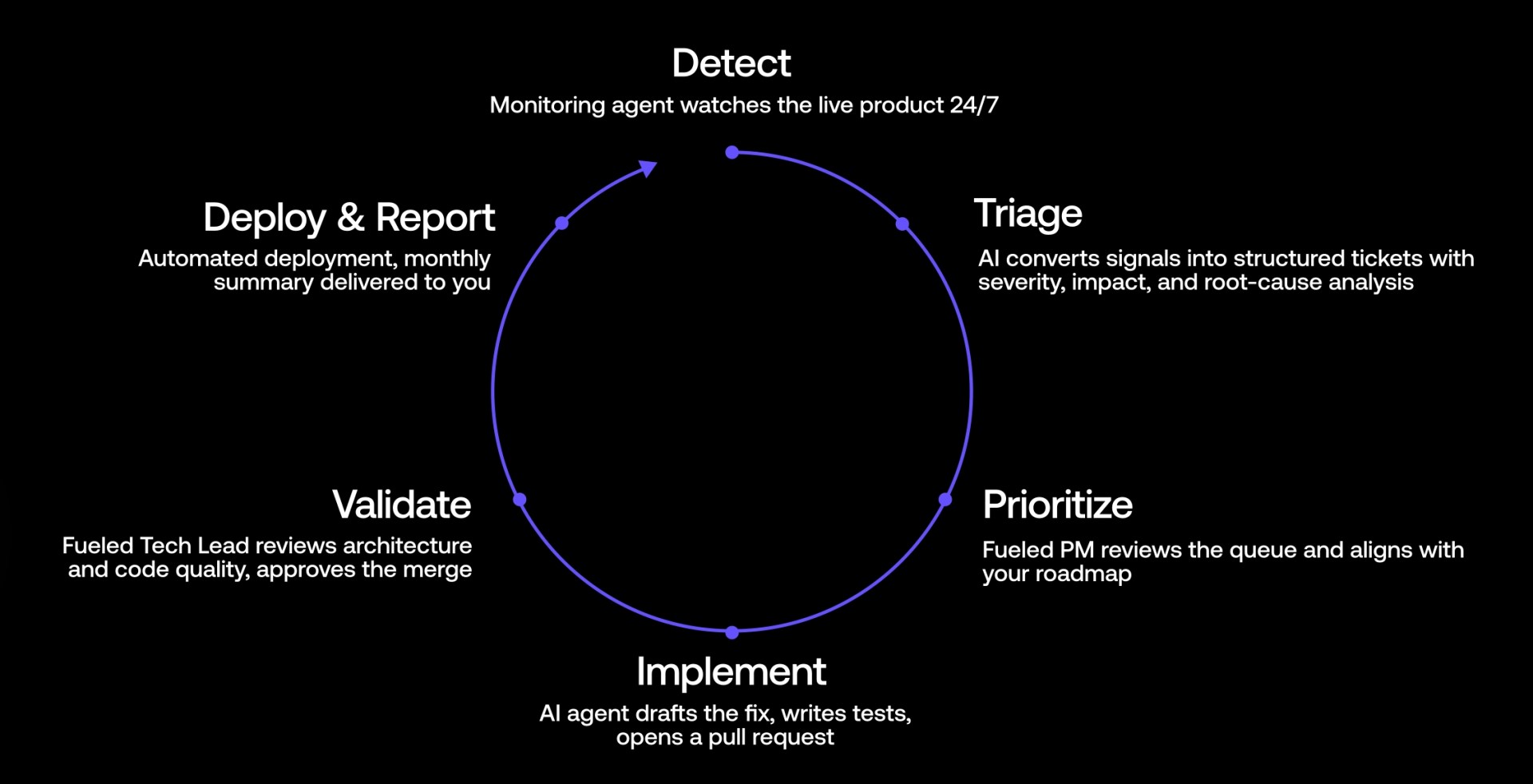
Agentic Post-Launch Support is built around a loop of continuous monitoring, automated triage, prioritization, implementation, validation, approved deployment, and monthly reporting.
In the current pilot, the workflow starts with product instrumentation and the systems product teams already use to understand application health. Runtime errors, crashes, downtime, performance regressions, and issue reports feed into the workflow through observability and issue-tracking tools such as Sentry and Linear.
Once a crash, performance issue, or bug report is captured in those tools, AI agents help turn it into a more actionable maintenance item, adding context such as severity, occurrence patterns, affected environments, and an initial diagnosis or root-cause hypothesis. That kind of rapid context gathering and pattern analysis is one of AI’s clearest advantages in maintenance: it gives experienced reviewers a structured starting point instead of forcing them to reconstruct an issue from scattered reports, logs, and faded product context.
Fueled product and engineering leads then review the queue. Some issues may be ignored, grouped, deferred, or routed into a larger roadmap discussion. For prioritized issues, the workflow currently integrates directly with GitHub-hosted repositories, where agents can inspect the relevant code, draft a proposed fix, add tests where appropriate, and open a pull request for Fueled review.
A Fueled technical lead validates the architecture, implementation quality, security implications, and product risk before any change is approved. Approved changes move through standard release workflows, with monthly reporting on what was caught, what was reviewed, what shipped, and what still needs attention.
As the model expands, those integration points will extend across additional monitoring, ticketing, code-hosting, and analytics platforms.
Human oversight stays central
Agentic AI can accelerate maintenance work, but live products still need accountable review.
That is why this program does not treat AI-generated fixes as ready to ship by default. Product and technical leads guide the workflow, then technical reviewers evaluate proposed changes before deployment. When a proposed fix is strong, it can move forward. When it misses the mark, the team can revise, redirect, or handle the issue manually.
This is one practical expression of Fueled’s AI-native delivery model: structured agentic capabilities shaped by human oversight, product judgment, engineering standards, and repeatable validation. Clients benefit from the efficiency and acceleration generative AI can offer without compromising the quality, accountability, or product judgment they expect from Fueled.
Where agentic maintenance fits
The pilot is currently focused on qualified web and mobile products with stable foundations.
When the work calls for new product direction, complex systems integration, or major architecture changes, the right model is still a dedicated digital product team. The Agentic Post-Launch Support program focuses on maintenance work that can be identified from product signals, investigated through a structured workflow, addressed with targeted fixes, and reviewed by experienced leads.
The strongest pilot candidates have clean, well-understood codebases, existing observability, and maintenance needs centered on bugs, performance, and small improvements. Products built by Fueled or recently vetted through a technical audit are strong fits because the team can evaluate the architecture, dependencies, risk profile, and support model with greater confidence.
Within that maintenance scope, coverage can include bug fixes and error resolution, performance optimization, dependency updates, security patches, accessibility improvements, CI/CD pipeline maintenance, and other targeted improvements.
This model is less appropriate for products with heavy unresolved technical debt, fragile architecture, many complex third-party integrations, or significant dependencies on internal client systems. Those conditions can make even small changes risky, which usually calls for a more traditional engineering engagement or a modernization effort.
Early pilot work is intentionally narrow and already providing useful signal. In small batches of maintenance issues, agents have drafted fixes that human reviewers accepted for most targeted issues, while also revealing where issues should be redirected, handled manually, or removed from the queue. The next phase is focused on making those results more measurable, repeatable, and useful for client-facing reporting.
In small batches of maintenance issues, agents have drafted fixes that human reviewers accepted for most targeted issues, while also revealing where issues should be redirected, handled manually, or removed from the queue.
Modernizing maintenance for the AI-native product era
More than ever, consumers expect digital products to be stable, trustworthy, and continuously improving. As AI accelerates what teams can ship, visible bugs and instability can reinforce fears that businesses are using AI to cut costs and ship faster at the expense of quality. At the same time, capable competitors are using AI to shorten product cycles, creating more pressure to focus product investment on improvements that move the product forward.
Agentic Post-Launch Support addresses both pressures directly. By turning product health signals into structured issues, drafting targeted fixes, and routing the work through expert review, Fueled can expand maintenance coverage while reducing routine overhead. That means more issues can be investigated, more fixes can be considered, and more human attention can stay focused on higher-value improvement.
The program reflects where Fueled is taking delivery in the generative AI era: AI-native systems that make routine work more efficient without removing human expertise and accountability or lowering the bar for craft. The goal is to help clients get more coverage, more momentum, and more product value from their ongoing product investments.
For organizations looking to keep a web or mobile product stable, secure, performant, and improving after launch, Fueled can help assess whether Agentic Post-Launch Support is a fit for the current pilot or a future expansion of the model.
Contact Fueled to discuss post-launch support for a web or mobile product.